Energy Trading
Platform UX
Designing Centrica Energy's internal portfolio management platform from the ground up — replacing fragmented legacy tools with a unified workspace that streamlines PPA quoting, pricing runs, and multi-stage approvals for energy traders and originators.
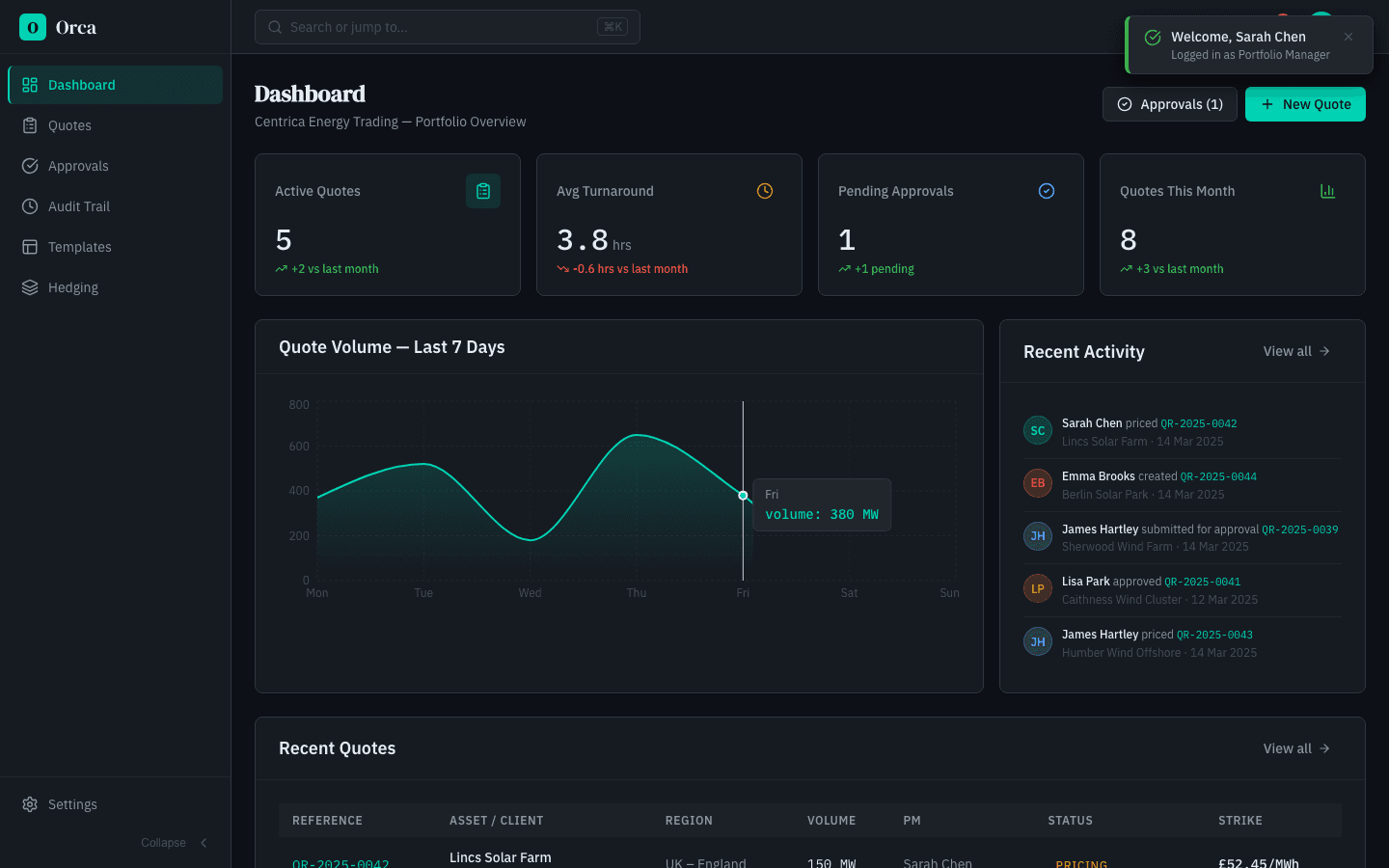
Orca — Centrica Energy's internal portfolio management platform. Dashboard showing live KPIs, quote volume and recent activity.
01 — Context & Challenge
A platform built for speed, stuck in the past
Centrica Energy originates, prices and approves long-term power purchase agreements across solar, wind, and BESS assets in the UK and Europe. These deals can run 10–25 years and carry hundreds of millions in exposure — yet the process was managed through disconnected spreadsheets, email threads, and legacy systems with no single source of truth.
I was brought in as Lead UX Designer to design a purpose-built portfolio management platform — Orca — covering the full lifecycle from quote creation through pricing runs, multi-stage approval, audit trail, and hedge seed management. I worked end-to-end alongside quants, engineers and front-office stakeholders.
02 — Research & Trader Interviews
Getting inside the trading desk
Before touching a single wireframe, I spent three weeks embedded with the trading desk — observing live sessions, shadowing traders through full trading days, and conducting structured interviews across different roles. The goal was to understand not just what people did, but the mental models and pressures shaping every interaction.
What traders told us
“I have no idea what stage a deal is at unless I go and ask someone. There's no visibility — it just disappears into email and you hope it comes back approved.”
— Originator, Centrica Energy
“Every pricing run is a new spreadsheet. I can't tell you which version we actually sent to the client — I'd have to dig through my inbox.”
— Portfolio Manager, UK Power
“Approvals take days because we're chasing people on Teams. There's no way to see who the bottleneck is or how long something's been sitting.”
— RAM Desk Analyst, Centrica Energy
- →Average time to get a quote to approval-ready: 3.8 hours across systems
- →100% of participants maintained personal shadow spreadsheets alongside official tools
- →Approval bottlenecks added an average of 1.4 days to deal turnaround
- →Originators spent ~35% of their time on coordination and chasing status, not originating
- →No consistent assumption templates — 6 different regional variants in active use
03 — Ideation & Low-Fidelity Prototypes
From insights to early concepts
Research findings fed directly into a two-day design sprint with the product and engineering team. We mapped the core workflows, identified the critical decision points, and explored multiple layout directions before committing to a direction.
Early lo-fi wireframes explored the core interaction model: a resizable dual-panel workspace giving traders control over their data layout, with an AI assistant integrated as a persistent panel — not a separate modal or external tool — so it could be queried in context without breaking focus.
Early lo-fi wireframe concept — dual panel layout with inline AI assistant
The AI assistant's position within the workspace was tested in three configurations: a floating overlay, a collapsible right-rail, and a full-height side panel. Traders consistently preferred the persistent side panel — it felt like having a colleague alongside, not a popup tool.
04 — User Testing Outcomes
Testing with real traders, real data
We ran two rounds of moderated usability testing with portfolio managers, originators and approval reviewers. Sessions used a Figma prototype connected to realistic mock data — real asset names, GBP/MWh pricing, MW volumes — so participants could engage authentically with the workflows.
- ✓Surfaced deal status more prominently on quote cards — reviewers needed it at a glance
- ✓Restructured the pricing workspace tabs after users couldn't find historical runs
- ✓Added persistent deal context (asset name, MW, region) to the approval view — reviewers kept navigating away
- ✓Introduced 'Clone Template' as a primary CTA on the templates page after originator confusion
- ✓Simplified the activity feed to show only actionable items by default, with a 'View all' option
05 — Final Design
The Orca platform — shipped
After four months of iterative design and development, the platform launched to the Centrica Energy trading desk. Here's the final product.
Dashboard — live KPIs (active quotes, avg turnaround, pending approvals), quote volume chart, and real-time activity feed.
Quote Requests
The quotes list replaces the chaos of shared inboxes and spreadsheet trackers. Every deal — solar PPA, wind PPA, BESS — is visible in a single filterable table with live status, asset type, region, volume (MW), strike price (£/MWh), and assigned PM. Status badges give instant visual triage across the full pipeline.
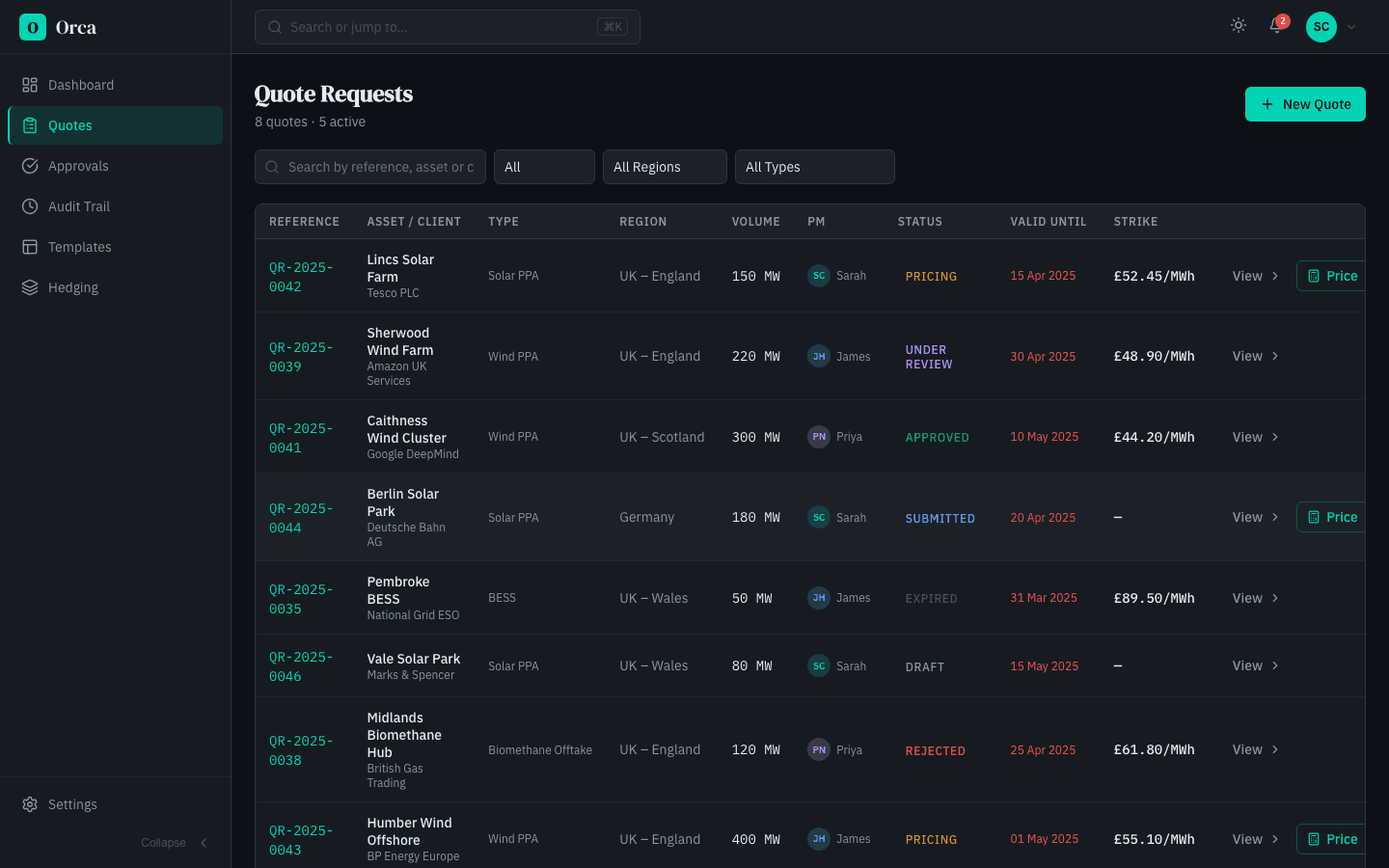
Quote Requests — 8 active deals across Solar PPA, Wind PPA and BESS in UK and Germany, with live status badges.
Pricing Workspace
The three-panel pricing workspace was the most complex screen to design. Quants needed to see Assumptions, live Market Data, and Pricing Output simultaneously — comparing strike price scenarios and curve shapes without losing context. We designed a persistent version history panel so every pricing run was captured and comparable, replacing ad-hoc spreadsheet versions.
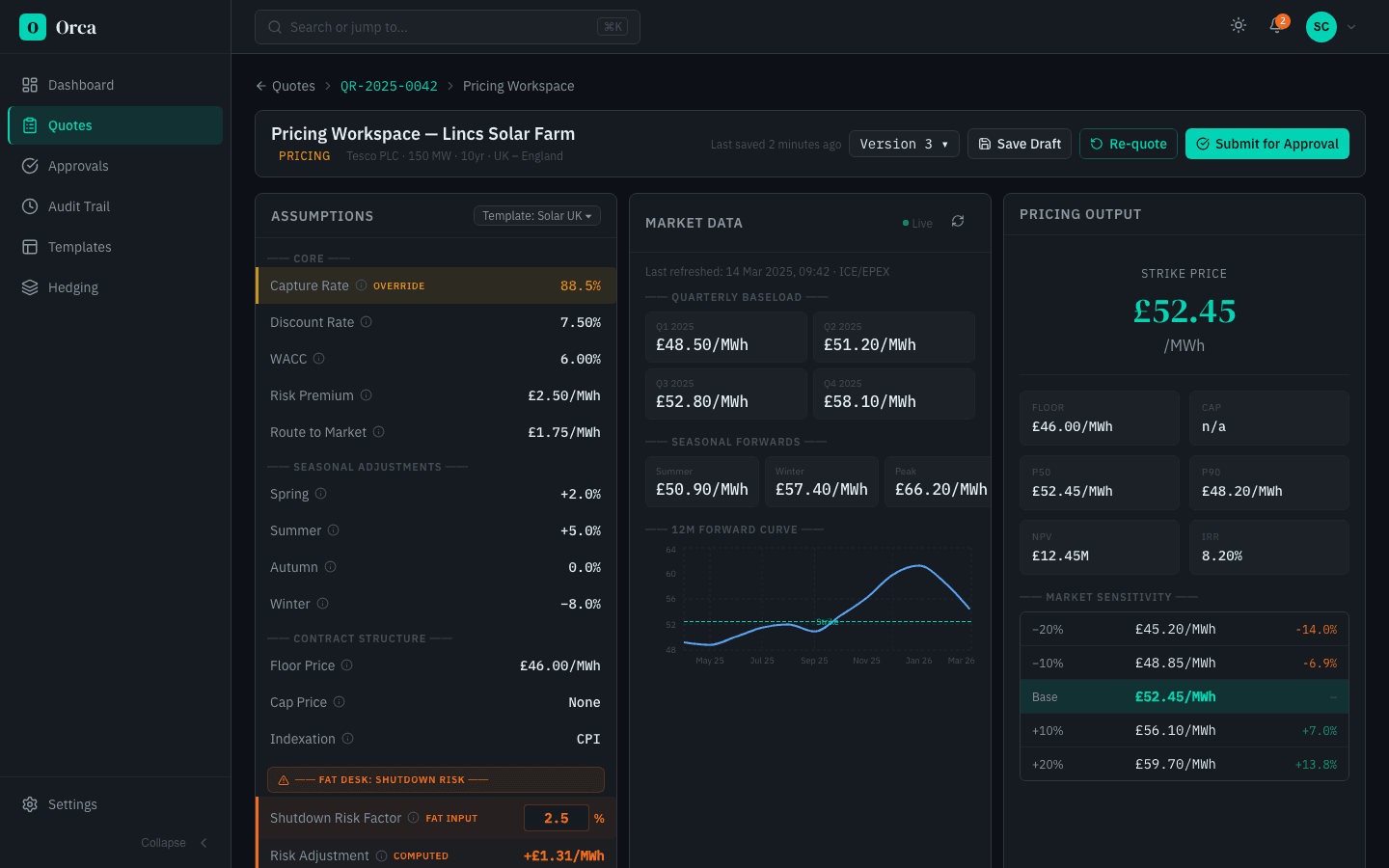
Pricing Workspace — Assumptions · Market Data · Pricing Output in a resizable 3-panel layout. Strike price: £52.45/MWh.
Approvals Queue
The approvals queue gives each reviewer — RAM Desk, FAT Desk, Finance — a personal view of deals awaiting their action. Reviewers can approve, reject, or request changes in one click, with deal context (asset, region, MW, strike price, IRR) surfaced inline so they never need to navigate away to find the numbers.
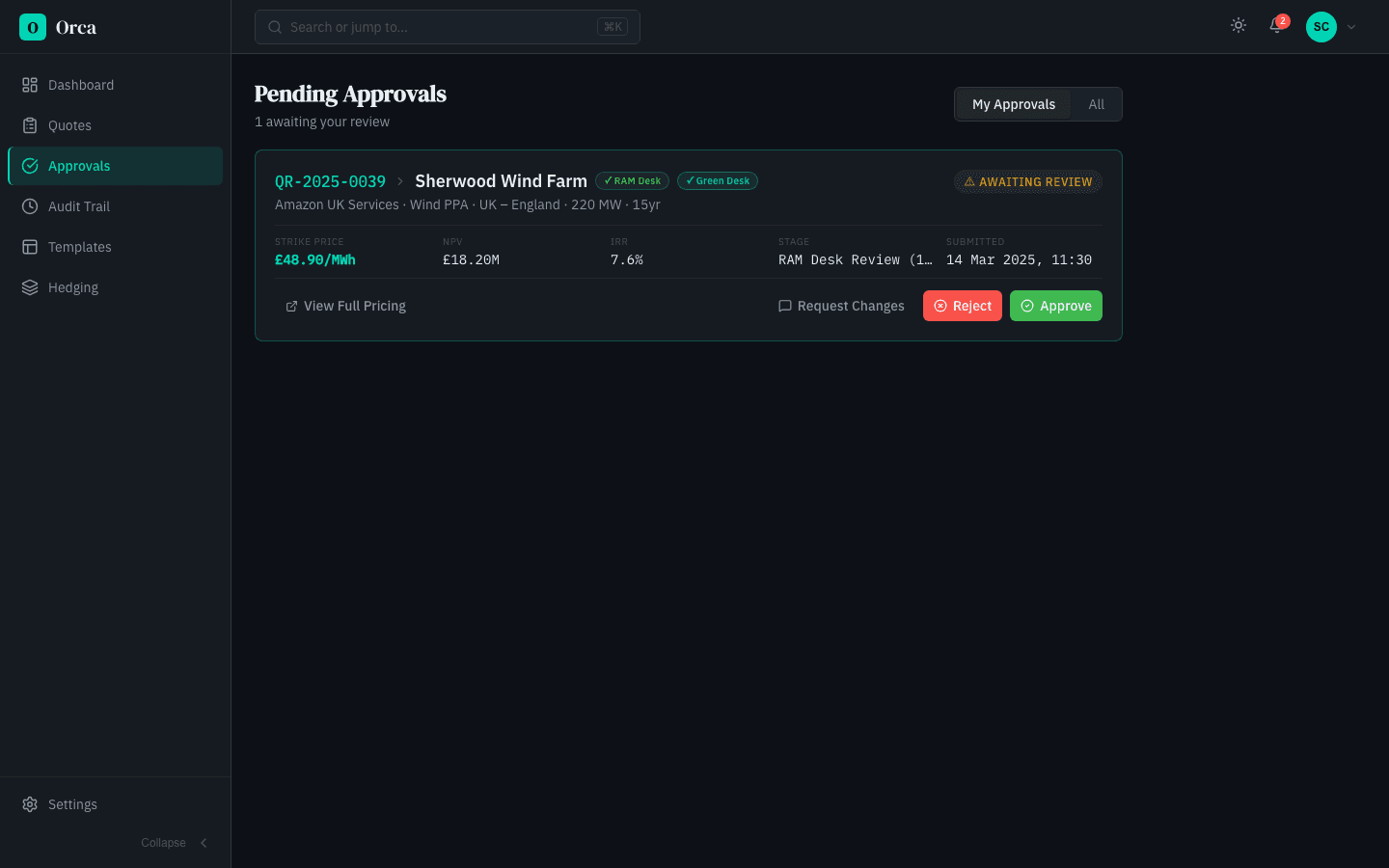
Approvals Queue — Sherwood Wind Farm (QR-2025-0039) awaiting RAM Desk review. £48.90/MWh · 220 MW · 15yr.
Assumption Templates
One of the biggest wins from research: inconsistent base assumptions were a root cause of rework and pricing disputes. We designed a template library — Solar UK Standard, Wind UK Standard, BESS Standard, Germany EEG — that originators can clone and adapt, ensuring consistent starting points across every deal type and region.
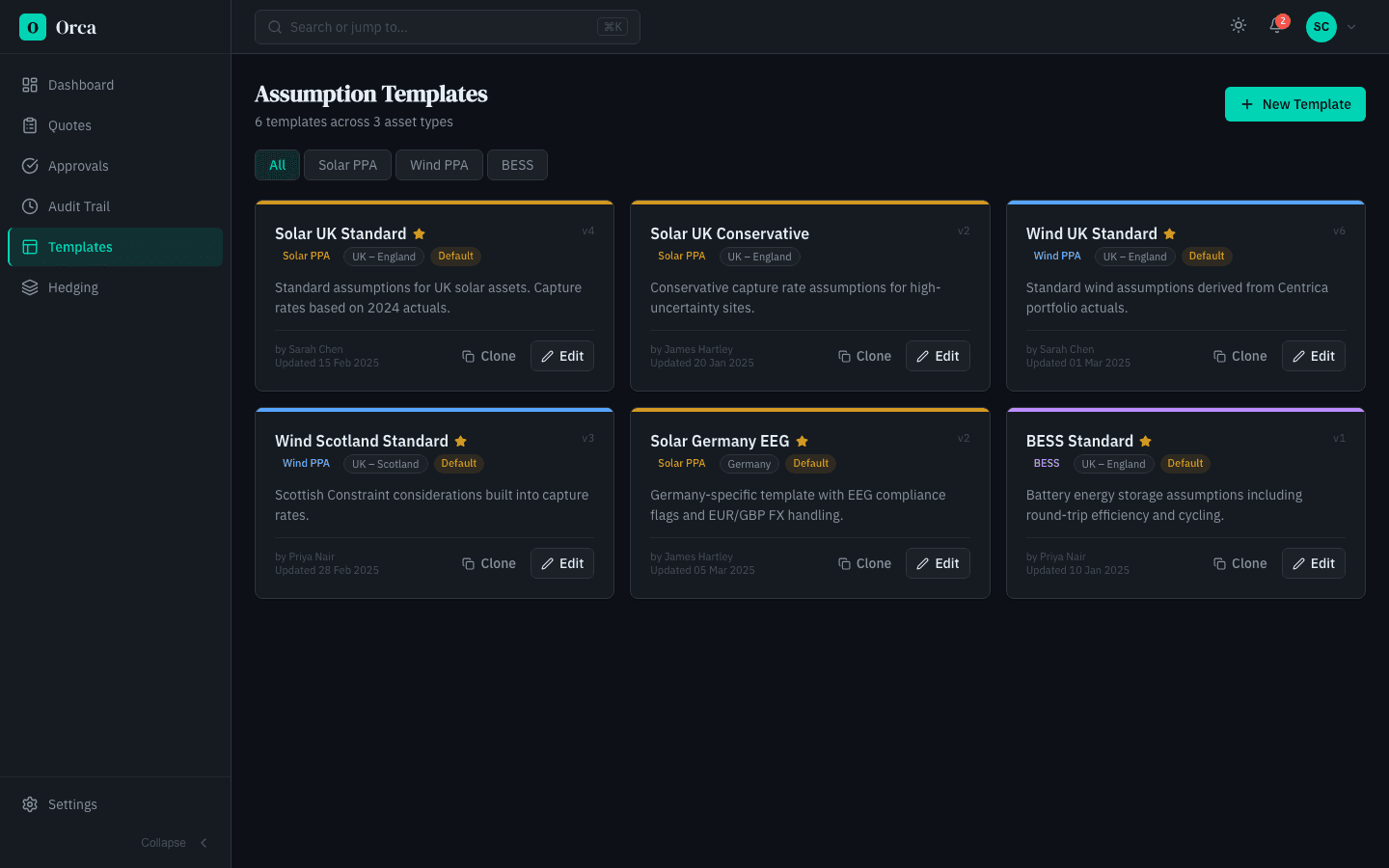
Assumption Templates — 6 standard templates across Solar, Wind, BESS and regional variants. Clone · Edit.
06 — Outcomes & Impact
Measurable results for the trading desk
This case study presents a condensed overview of the work. Detailed research outputs, full design specifications, and platform internals are confidential to Centrica Energy. I'm happy to walk through the full process in conversation — please get in touch.